Cost of Hiring Site Security Cameras: 2026 Pricing and ROI Guide
Did you know that construction site theft and vandalism cost the Australian industry over A$800 million every year? For a project manager, these figures represent more than just financial loss; they mean blown schedules, delayed handovers, and rising insurance premiums. You understand that visibility is your best defense, yet the true cost of hiring site security cameras often remains hidden behind complex contracts, relocation charges, and surprise data fees. You need a reliable, off-grid solution that provides total accountability without the logistical headache of traditional power requirements.
We agree that your site security shouldn't be a source of financial uncertainty. This guide provides a transparent breakdown of 2026 rental fees for solar-powered camera towers, ensuring you can forecast your weekly spend with precision. We'll explore installation logistics, data management, and the specific ROI benefits of automated surveillance over expensive static guards. From remote infrastructure projects to urban developments, you'll gain a clear roadmap to securing your assets while maintaining a lean, efficient project budget.
Key Takeaways
- Understand the managed hire model used by professional Australian providers and how weekly rental rates scale with project duration and technology needs.
- Analyze the significant price gap between physical guarding and autonomous surveillance to see how a single solar tower replaces multiple guard checkpoints.
- Secure a transparent breakdown of the cost of hiring site security cameras in A$ to ensure project budget accuracy from civil works through to final fit-out.
- Identify why professional hire services deliver greater value than DIY setups by ensuring 99.9% uptime through Telstra 4GX and AWS integration.
- Evaluate the long-term ROI of solar-powered surveillance by comparing managed rental fees against the high cost of site theft and project downtime.
Factors Influencing the Cost of Hiring Site Security Cameras
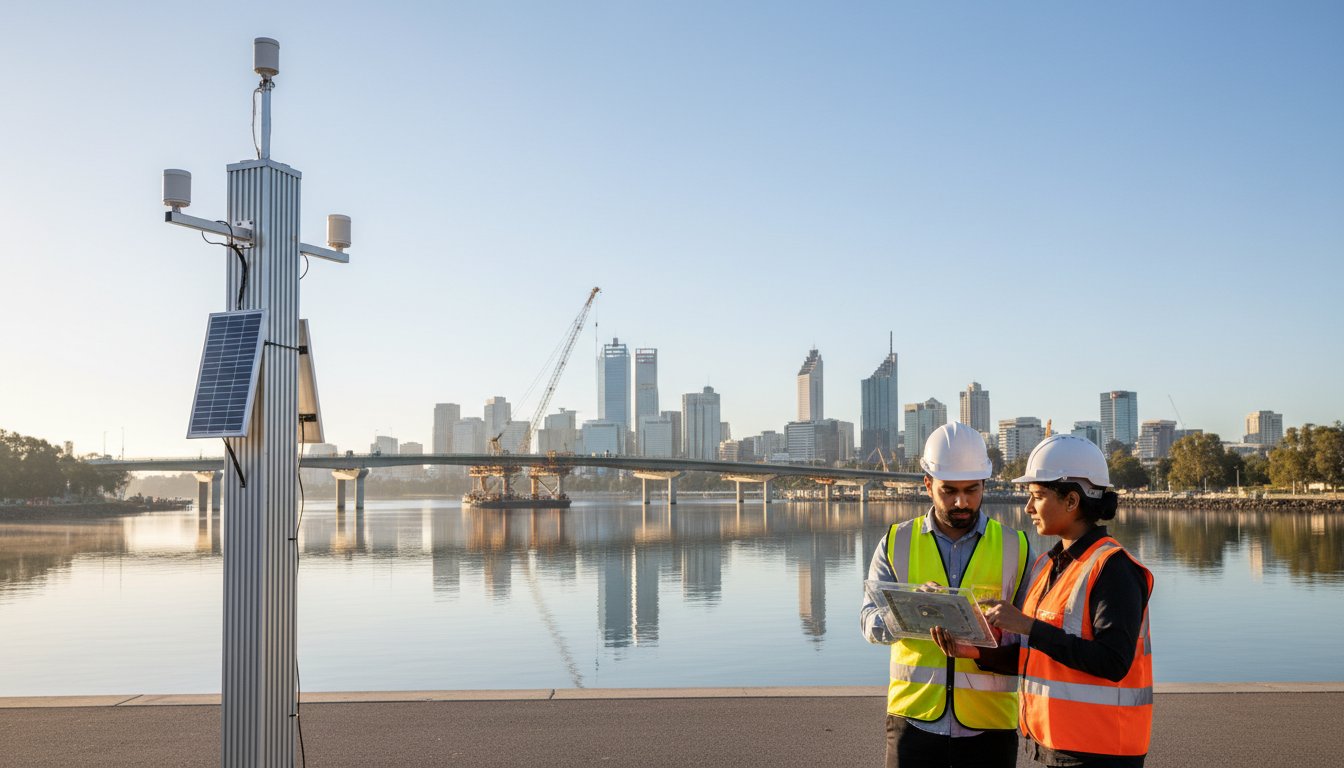
Calculating the cost of hiring site security cameras requires looking beyond the base weekly rental fee. In 2026, Australian project managers prioritize visibility and risk mitigation through technology that works without site power. The investment in solar-powered camera towers depends on hardware intelligence and deployment duration. Off-grid systems using 4GX connectivity and high-capacity solar arrays carry higher weekly rates than basic tethered units. This premium covers the elimination of expensive trenching costs and the need for licensed electrical trades to run cables across a live site.
Sophisticated hardware reduces the need for physical guards. A single high-specification tower can monitor a perimeter that previously required multiple fixed points. This efficiency creates a direct relationship between the technology tier and the total project investment. High-definition optics and reliable power reserves ensure 24/7 accountability, even during consecutive days of low sunlight in southern Australian states.
Hardware Specifications and Security Tiering
Hardware capabilities drive the primary variance in rental rates. Standard units provide high-definition recording, but advanced towers integrate AI-powered analytics. These systems detect missing PPE or identify unauthorized vehicles through License Plate Recognition (LPR). Integrating a Closed-circuit television (CCTV) solution with 360-degree Pan-Tilt-Zoom (PTZ) functionality allows for active site management from any location. This functionality commands a higher price point but offers a superior ROI for large-scale infrastructure projects by replacing several static cameras with one dynamic unit. Solar site cameras equipped with thermal sensors or strobe deterrents provide an even higher level of site hardening.
Hire Duration and Volume Discounts
The length of the rental agreement significantly impacts the final cost of hiring site security cameras. Short-term hire for a six-week civil works phase typically attracts a higher weekly rate due to the logistics of delivery and commissioning. Long-term contracts for major 24-month developments allow providers to offer lower recurring rates. Multi-unit deployments also provide financial leverage. Scaling from two towers to ten units on a massive subdivision project often triggers volume discounts that reduce the per-unit cost by 15% to 20%.
Choosing hire over capital expenditure (CapEx) provides distinct financial advantages for temporary projects. Rental payments are generally treated as an operating expense (OpEx), which assists with project cash flow and provides immediate tax benefits. This model ensures the site always has access to the latest 2026 sensor technology without the burden of equipment depreciation or maintenance costs. Using temporary site security cameras allows for a scalable security footprint that grows or shrinks as the project reaches different phases of completion.
The Three Pillars of Site Security Rental Pricing
The managed hire model is the standard for professional Australian construction projects. It moves site security from a capital expense to an operational one. This model ensures you aren't just renting a piece of hardware; you're securing a guarantee of uptime and visibility. Transparency in your fee structure is the only way to maintain project budget accuracy. When evaluating the cost of hiring site security cameras, look for providers who bundle technical support and hardware refreshes into a single monthly figure. This prevents the hidden "service fee" traps that often emerge mid-project. Effective building site CCTV relies on this comprehensive approach to ensure every blind spot is covered without unexpected financial strain.
Recurring Equipment Rental and Maintenance Fees
Your weekly or monthly hire fee is the heartbeat of the security contract. For a professional-grade solar camera tower in 2026, this fee covers the physical unit, the high-capacity solar array, and the internal battery storage systems. It also includes essential firmware updates that protect against evolving cyber threats. Leading Australian providers now include proactive maintenance in the base rental price. This means technicians monitor battery health and lens clarity remotely, often fixing issues before your site manager even notices a drop in performance. Budgeting for a premium service ensures you don't face downtime during critical project phases.
Professional Installation and Relocation Charges
Precision setup is a non-negotiable one-off cost. Professional installers perform signal strength testing and optimal angle calibration to eliminate dead zones. While DIY options seem cheaper, the cost of a single missed incident due to poor placement far outweighs the initial setup fee. You must also budget for site boundary changes. As a build progresses from excavation to fit-out, the perimeter shifts. Relocation charges for solar towers usually range between A$350 and A$600 per move, depending on the complexity of the new position. Planning for at least two relocations during a twelve-month project is a realistic baseline for most Tier 1 and Tier 2 developments.
Managed Cloud Storage and 4GX Connectivity
Connectivity is the backbone of modern site oversight. Relying on Telstra 4GX data ensures 24/7 remote visibility even in fringe suburban zones or new land releases. Secure AWS cloud hosting is a mandatory cost for retention. It protects your footage from physical theft or tampering on-site. Many project managers fall into the "cheap camera trap" by using units that only record to local SD cards. If the camera is stolen or damaged, your evidence vanishes. High-speed data links are also essential for improving construction site security through AI-driven analytics that distinguish between a wandering animal and a genuine intruder. To get a precise breakdown for your specific perimeter, you can request a tailored solar camera quote based on your site plan.
Cost Comparison: Solar Camera Hire vs. On-Site Security Guards
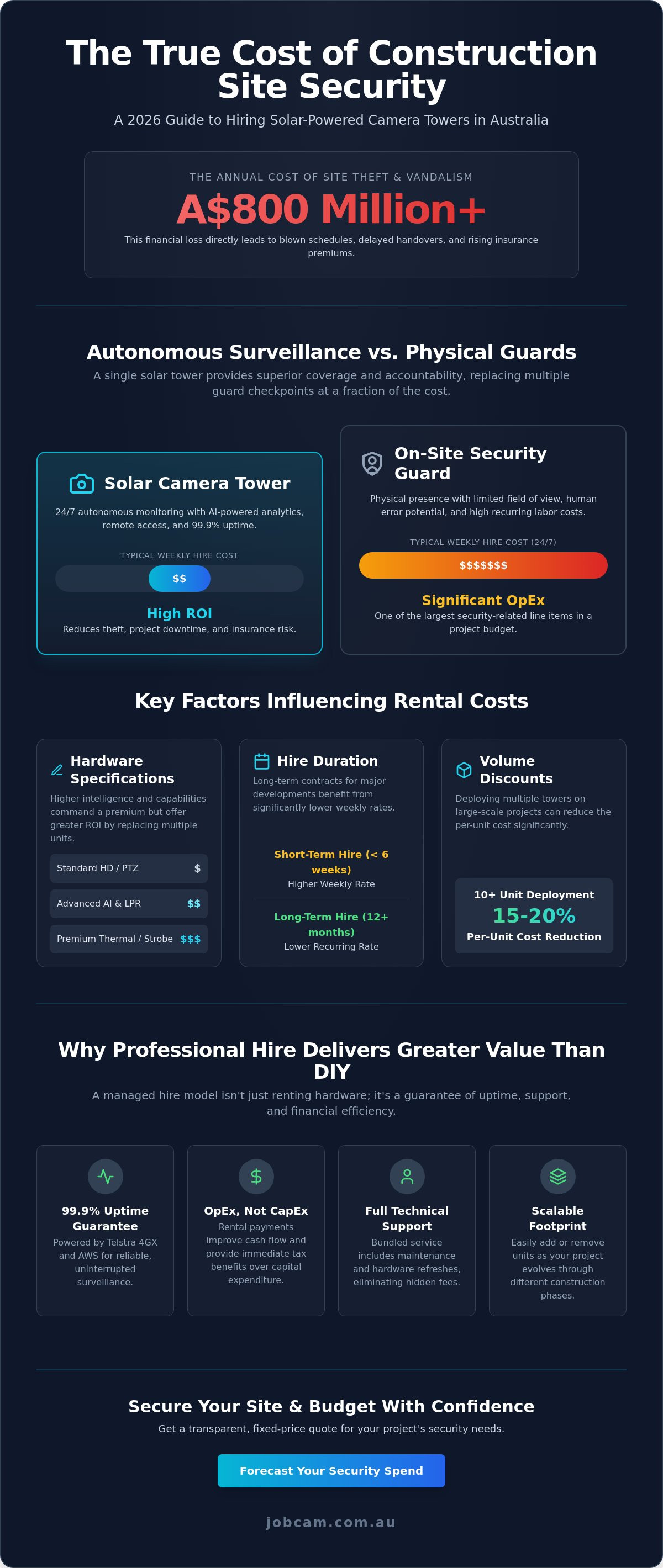
The financial gap between traditional physical guarding and autonomous surveillance is staggering. For most Australian developers, the cost of hiring site security cameras represents a strategic shift from high-margin labour costs to efficient, fixed-price technology. A single solar camera tower provides a 360-degree field of view that often replaces two or three static guard checkpoints. Unlike human personnel, these towers don't require breaks, lighting, or onsite amenities. They deliver consistent, high-definition monitoring without the risk of fatigue or oversight.
Relying on physical guards introduces significant hidden expenses that often bloat a project budget. You aren't just paying for a person; you're paying for management overhead, recruitment, and insurance premiums. In Australia, penalty rates for night shifts, weekends, and public holidays can double your security spend instantly. Human error remains a critical vulnerability, as a guard can only be in one place at a time. Switching to temporary site security cameras eliminates these variables, providing a persistent digital perimeter that never sleeps.
The Annual Savings Breakdown
The numbers tell a clear story of fiscal responsibility. Hiring a solar camera tower typically costs around A$130 per week, whereas a 24/7 guard service in Australia frequently exceeds A$5,000 per week. Over a standard six-month construction project, the guard service costs approximately A$130,000. In contrast, the solar tower hire totals just A$3,380 for the same period. This represents a 97% reduction in direct security expenditure. An autonomous solar tower operates at approximately A$0.77 per hour, while a single human guard under Australian award rates costs upwards of A$65 per hour including overheads. This massive ROI allows project managers to reallocate hundreds of thousands of dollars back into materials or labour.
Beyond the Dollar: Accountability and Evidence
Financial savings extend into risk mitigation and insurance. High-definition video evidence is an essential asset for defending against fraudulent insurance claims and workplace injury disputes. Following OSHA construction industry standards ensures your site remains compliant, but visual data proves that compliance in real-time. This transparency reduces the cost of hiring site security cameras even further by preventing expensive legal battles.
Solar towers also eliminate the "false alarm" costs associated with traditional security. Real-time alerts sent directly to your smartphone allow for immediate visual verification before you trigger an expensive security patrol call-out. You can use this same surveillance data to resolve subcontractor liability issues or delivery disputes. If a supplier claims they delivered materials that aren't on-site, the timestamped footage provides the definitive answer, saving hours of administrative back-and-forth and potential replacement costs.
How to Budget for Multi-Phase Construction Site Surveillance
Effective budgeting requires a granular understanding of how site risks shift over time. You don't need the same configuration on day one that you're going to need during the final week of fit-out. Calculating the cost of hiring site security cameras involves mapping equipment needs against project milestones to ensure you're never over-provisioned or under-protected. It's about matching the technology to the phase of the build.
Early Phase: Securing Vacant Land and Civil Works
Before the first fence post is in the ground, your site is most vulnerable. Civil works often involve high-value earthmoving equipment left in open, unlit areas. Budgeting for solar site cameras at this stage is a strategic necessity. Since these sites lack power and data infrastructure, solar towers provide immediate, autonomous protection. These units act as high-visibility deterrents. They signal to potential intruders that the site is monitored 24/7. This early investment prevents material theft and vandalism that can delay an Australian project by weeks before it even gains momentum. You're paying for peace of mind while the ground is still being broken.
Mid-to-Late Phase: Interior Security and Fit-Out
As the structure rises, your surveillance strategy must evolve. The focus shifts from perimeter defense to internal accountability and project management. The cost of hiring site security cameras during this phase often includes units equipped with AI for PPE detection and site safety compliance. This helps project managers monitor 100% of the site without being physically present in every zone. High-definition time-lapse functionality serves a dual purpose here. It's a security log and a high-impact marketing asset. By the time you reach the final handover, you have a complete visual record of the build. This footage is invaluable for stakeholder reporting and future business development. It transforms a necessary security expense into a long-term branding tool that allows you to see your site from anywhere. To further optimize your project's digital presence, check out Patio SEO for expert growth solutions in the Australian market.
- Identify high-risk zones during civil works to place towers effectively.
- Scale camera numbers up as internal fit-outs begin and high-value materials are stored inside.
- Utilise AI analytics to automate safety reporting and reduce manual oversight costs.
- Leverage time-lapse data for post-project reviews and marketing collateral.
Budgeting for these phases ensures you aren't paying for idle equipment. It keeps your site secure and your project moving forward without unexpected financial hits from theft or safety breaches.
Why Professional Hire Services Deliver Greater Value than DIY
Opting for retail "plug-and-play" cameras often creates a false sense of security. While the upfront price of a consumer unit seems low, the hidden costs of downtime and data loss are substantial. Retail cameras rely on local SD cards or unstable consumer Wi-Fi, making them easy targets for thieves who simply steal the camera and the evidence with it. In contrast, the cost of hiring site security cameras through a professional partner covers a managed ecosystem designed for high-stakes environments.
Jobcam eliminates these vulnerabilities by ensuring 99.9% uptime. Our solar-powered towers utilize the Telstra 4GX network for constant connectivity, even in remote regions. All footage is encrypted and stored off-site on Australian-based AWS servers. This means if a unit is tampered with, your data remains safe and accessible. Professional construction site cameras provide a level of redundancy that DIY setups cannot match, ensuring you never face a "data gap" during a critical incident.
The Jobcam Managed Service Advantage
A managed hire service removes the technical burden from your project team. We handle the maintenance, firmware updates, and hardware optimisations. If a technical glitch occurs, our team provides instant support to get the system back online. This reliability allows you to see your site from anywhere, providing 24/7 visibility that goes beyond mere theft prevention.
The Jobcam app transforms your security hardware into a project management asset. You get real-time access to high-definition feeds, allowing for remote site inspections and progress tracking. This dual utility means the cost of hiring site security cameras is offset by the time saved on travel and manual reporting. It's a tool for accountability as much as it is for protection.
- Off-site Security: Footage is stored on secure Australian servers, not on the device.
- Reliable Power: Solar-powered towers operate independently of site power grids.
- Instant Connectivity: Industrial-grade 4GX ensures a stable connection in 98% of populated areas.
- Dual Purpose: Use the same system for security and stakeholder reporting.
Getting a Tailored Site Security Quote
No two project sites are identical. A 5,000 square metre warehouse build requires a different configuration than a linear infrastructure project. Generic DIY kits don't account for blind spots or specific site topography. Choosing a national provider with a proven Australian track record ensures your setup is fit for purpose from day one.
A site-specific assessment leads to more accurate budgeting. It prevents the common mistake of over-hiring unnecessary units or under-protecting high-value assets. When you partner with experts, you aren't just renting hardware; you're securing a commitment to site uptime and project transparency. Take the first step toward total site visibility today.
Request a professional site security hire quote from Jobcam
Secure Your Site Margin Through 2026
Managing a construction budget requires foresight and a focus on high-impact technology. By 2026, the transition from expensive manual guarding to integrated solar camera rental will be the baseline for cost-conscious project managers. You're not just renting hardware. You're investing in 24/7 accountability and real-time visibility that traditional methods can't match. It's about protecting your bottom line while maintaining a clear record of every project milestone.
Understanding the cost of hiring site security cameras is the first step toward eliminating site theft and avoidable project delays. JobCam brings over 10 years of construction site expertise to every deployment across our national Australian service coverage. Our systems are backed by Telstra 4GX and AWS for Tier-1 reliability. This ensures your feed stays live when it matters most. It's a professional, no-nonsense extension of your team that delivers peace of mind from ground-break to final handover.
Secure your project today with a custom solar camera hire quote
We're ready to help you see your site from anywhere and build with total confidence.
Frequently Asked Questions
How much does it cost to hire a construction site security camera per week?
Weekly rental rates for solar camera towers in Australia typically range from A$150 to A$350 depending on the technology package and hire duration. Infrastructure projects often secure lower rates compared to short-term residential builds. This cost of hiring site security cameras covers the hardware, 24/7 monitoring capabilities, and the mobility of the solar unit. It provides a fixed cost for your project budget.
Are there extra charges for data and cloud storage?
Most hire agreements bundle data and cloud storage into the flat weekly fee to ensure predictable budgeting. High-definition recording requires significant bandwidth, so we include 4G or 5G connectivity as standard. You won't face hidden overage charges when reviewing footage or exporting time-lapse sequences for stakeholder reports. This approach simplifies your monthly accounting and ensures the tower remains online 24/7 without interruption.
Do I have to pay for the installation of the solar camera tower?
A one-off mobilization fee applies to the delivery and setup of the solar camera tower. This fee covers the transport to your site and the technical calibration required for optimal coverage. Because these units are self-powered and wireless, there are no electrical trenching costs, which saves you approximately A$2,000 in site preparation fees compared to wired systems. It's a rapid deployment solution.
What happens to the cost if I need to move the camera during the project?
Moving a solar tower during a project incurs a standard relocation fee to cover the logistical cost of the transport vehicle. Since the towers are built on a modular, towable chassis, the process is rapid and doesn't require permanent decommissioning. You only pay for the technician's time and the transport, keeping your site layout flexible as construction progresses. This ensures your security evolves with the site.
Is hiring a security camera tower tax-deductible for my business?
Hiring security equipment is generally treated as a 100% tax-deductible operating expense (OPEX) for Australian businesses. Unlike purchasing assets that depreciate over several years, rental payments can be claimed in the same financial year they occur. This improves your cash flow and reduces your taxable income immediately. We recommend consulting with a certified tax professional to confirm how these deductions apply to your specific company structure.
How does the cost of hire compare to buying the equipment outright?
Hiring a solar tower eliminates the heavy upfront capital expenditure (CAPEX) and ongoing maintenance liabilities. Buying a professional-grade solar tower can cost upwards of A$15,000, excluding the costs of software updates and hardware repairs. The cost of hiring site security cameras allows you to access the latest 2026 technology without the risk of equipment obsolescence. You get premium protection without the ownership burden.
Are there discounts available for hiring multiple security towers?
Volume discounts are available for large-scale developments requiring three or more solar towers. We scale our pricing to support multi-stage projects, offering reduced weekly rates for fleet deployments. This ensures comprehensive perimeter protection and multiple viewing angles across expansive sites while maintaining a cost-effective security budget for the project manager. It's a strategic way to cover large boundaries without multiplying your costs linearly.
Does the hire fee include technical support and maintenance?
Your hire fee includes comprehensive technical support and routine maintenance for the duration of the contract. If a hardware issue occurs, we handle the repairs or swap the unit to ensure zero downtime on your site. This "set and forget" service model means you don't need internal IT resources to manage your site's visual security or time-lapse recording. We provide the expertise so you can focus on construction.