
Using Time-Lapse to Analyse Construction Workflow: A 2026 Manager’s Guide
A single unexplained delay on an Australian Tier 1 project can cost upwards of A$50,000 per day in liquidated damages, yet many managers still rely on fragmented site diaries to settle disputes. You've likely felt the frustration of subcontractor arguments over site presence or the gridlock of delivery trucks at a narrow entry point. It's clear that manual oversight isn't enough to protect your margins in 2026. This guide shows you that using time-lapse to analyse construction workflow is the key to transforming raw footage into a high-impact analytical tool.
We'll explore how to use visual data to verify subcontractor hours, resolve delay claims with objective evidence, and streamline your site logistics for a leaner, more transparent project. You'll learn how to move beyond simple progress monitoring and start identifying specific bottleneck patterns that slow down your critical path. From providing stakeholders with total visibility to optimizing your delivery schedules, this article outlines how to make every frame of your JobCam footage work for your bottom line. It's time to replace guesswork with data-driven site management.
Key Takeaways
- Understand the transition to Visual Project Intelligence (VPI) and how daily site footage can drive immediate management decisions.
- Identify hidden logistical bottlenecks by reviewing vehicle movements and material handling to optimise site access and layout.
- Discover the efficiency of using time-lapse to analyse construction workflow compared to the subjectivity and time-drain of manual site diaries.
- Learn the optimal capture intervals and strategic camera placements required to produce analytical-grade data for your project timeline.
- Leverage Jobcam’s cloud platform and Telstra 4GX reliability to maintain total site oversight and stakeholder transparency from any device.
The Shift from Marketing to Management: Why Analyse Construction Workflow with Time-Lapse?
Construction management has evolved beyond simple oversight. In 2026, project leads are moving away from traditional site diaries and toward Visual Project Intelligence (VPI). This discipline involves the systematic review of site footage to identify bottlenecks and improve labor efficiency. While project teams once used cameras primarily for "end-of-project" marketing reels, the modern standard focuses on daily analytical streams. You aren't just capturing progress; you're harvesting data to drive better decisions on the ground.
Using time-lapse to analyse construction workflow allows managers to spot patterns that are invisible in real-time. A site manager walking the floor sees a moment; a VPI review sees a trend. This transition from passive recording to active analysis reduces project overheads by highlighting redundant movements and material staging errors. For Australian Tier 1 and Tier 2 contractors, this visibility is the difference between meeting a milestone and paying liquidated damages.
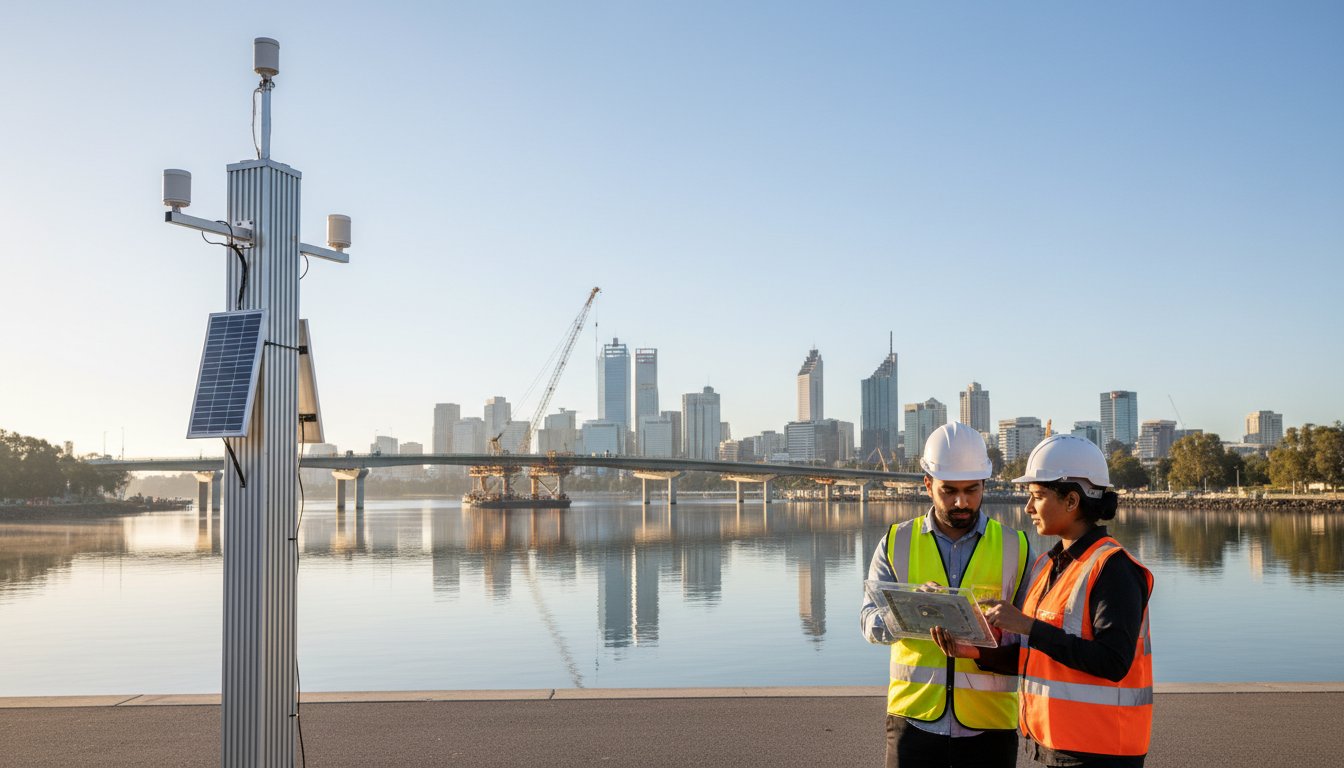
The choice of hardware determines the quality of your data. Cheap, DIY camera setups often fail due to connectivity drops or power shortages during Sydney's or Melbourne's overcast weeks. Hiring high-end, solar-powered camera towers ensures a 100% uptime guarantee. It's a strategic move. By opting for a professional hire service, you secure industrial-grade reliability without the capital expenditure or the maintenance burden of owning obsolete tech. Consistent data is the only way to build a reliable workflow model.
Visual Data as a Source of Truth
Site meetings often devolve into conflicting accounts of why a specific task stalled. Visual data eliminates these "he-said, she-said" scenarios instantly. When you use time-lapse photography to document every hour of production, you create an indisputable record of site activity. This footage verifies weather-related delays against Bureau of Meteorology data with timestamped precision. Integrating this visual proof into weekly stakeholder reporting builds total transparency and protects your reputation during contract disputes.
The ROI of Workflow Analysis
The financial impact of workflow oversight is immediate. Identifying a 5% efficiency gain in concrete pours or crane cycles can save a project upwards of A$15,000 in labor and equipment hire over a six-month period. By using time-lapse to analyse construction workflow, managers can also reduce the frequency of physical site visits. You can maintain total oversight of multiple locations using remote monitoring cameras from a central office. This capability slashes travel costs and allows your most experienced supervisors to impact more projects simultaneously, maximizing their value across the entire portfolio.
Identifying Site Bottlenecks: Using Visual Data to Optimise Logistics
Effective material handling relies on a layout that minimizes double-handling. Monitoring storage zones via solar-powered camera towers highlights if materials are placed in the way of future works, causing unnecessary relocations. This process mirrors the methodology found in work simplification studies, which emphasize that visual observation is key to reducing wasted motion. On a typical high-rise project in Sydney or Melbourne, tracking crane utilization identifies 'idle time' that threatens the critical path. If a crane sits stationary for more than 20 minutes during peak hours, the visual record helps managers re-sequence lifts to maintain momentum.
Waste removal and site clearing cycles are frequently overlooked bottlenecks. Time-lapse archives show the frequency of skip bin rotations and the buildup of debris. Optimising these cycles ensures the site remains safe and navigable, preventing the 10% slowdown often caused by cluttered workspaces.
Logistics and Delivery Management
Subcontractor Coordination and Accountability
Maintaining a tight schedule depends on subcontractor performance and presence. Managers monitor crew sizes and arrival times to ensure compliance with the project’s resource plan. If a plumbing team arrives with three workers instead of the promised five, the visual record provides the evidence needed for immediate rectification. Using footage to verify work-in-progress (WIP) simplifies progress payment approvals, reducing disputes by 25% through clear, timestamped documentation. This constant visibility also allows for the identification of safety trends, such as PPE lapses or incorrect scaffolding use, before they escalate into reportable incidents. If you want to see how this transparency improves your site oversight, consider how remote monitoring solutions can bridge the gap between the office and the field.
Time-Lapse vs. Manual Site Reporting: A Comparison for Project Managers
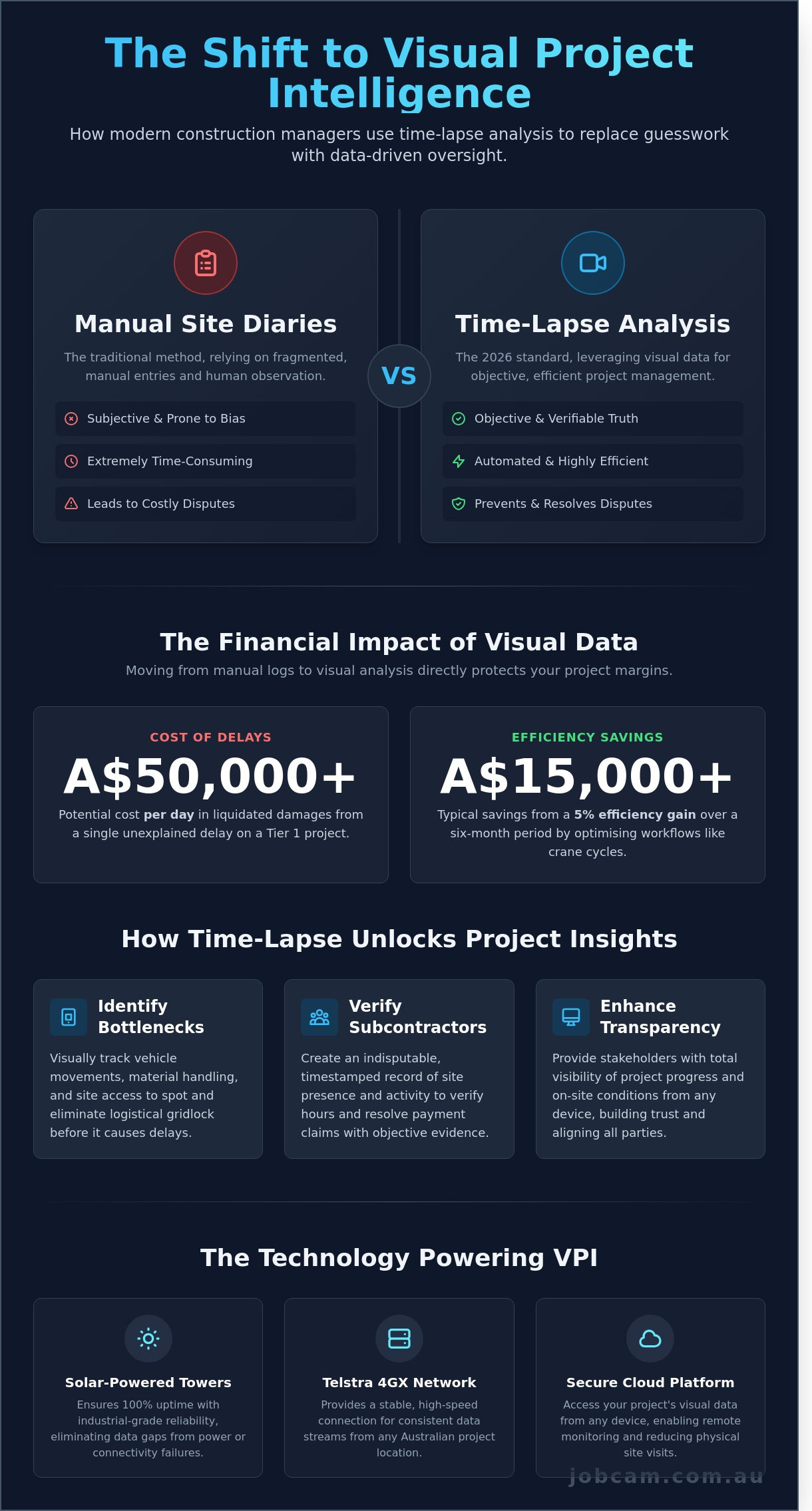
Manual site diaries rely on memory and perspective. They are inherently subjective. A project manager might spend 30 to 60 minutes daily documenting progress, yet critical details often slip through the cracks. Using time-lapse to analyse construction workflow replaces these narrative gaps with hard, visual evidence. While a manual report might note that concrete pouring commenced in the afternoon, a time-lapse sequence shows the exact minute the first truck arrived, the rate of the pour, and any bottlenecks in the delivery cycle.
Data granularity is the primary differentiator. Manual reporting usually captures a handful of static photos once a day, which misses 99% of site activity. In contrast, JobCam’s solar-powered towers capture high-definition frames every five to ten minutes. This creates a continuous, objective record. Project managers save an estimated 4 to 6 hours per week by utilizing automated visual data instead of chasing subcontractors for status updates or manually compiling photographic logs. This shift moves the manager from a data collector to a data analyst.
Bridging the Communication Gap
Transparency is the foundation of trust between contractors and owners. By providing stakeholders with direct access to the construction site cameras portal, you eliminate the need for lengthy email chains and status requests. Owners can log in from any location to see real-time progress. Short, high-speed clips of major milestones, such as a structural steel topping out, can be generated and shared instantly. This factual evidence improves the quality of board-level presentations, replacing vague progress percentages with undeniable visual proof of site momentum.
Investigative Analysis and Dispute Resolution
When things go wrong, memory is a poor witness. Historical playback allows teams to travel back in time to the exact moment an error occurred. This is vital for resolving disputes regarding site damage or delivery schedules. A 2024 industry survey indicated that clear visual documentation can reduce the time spent on dispute resolution by over 40%. It provides a factual basis for insurance claims, removing the guesswork from liability assessments.
Cloud-stored footage also serves as a critical asset for site protection. If site theft or vandalism occurs, the high-definition record remains safe in the cloud, even if the hardware on-site is targeted. This level of accountability ensures that using time-lapse to analyse construction workflow protects both the project schedule and the bottom line. It turns the job site into a transparent environment where every action is recorded and every milestone is verified.
Best Practices for Capturing Analytical-Grade Time-Lapse Footage
High-quality data is the foundation of any meaningful site audit. When using time-lapse to analyse construction workflow, your capture settings must align with your analytical goals. A standard 15-minute interval works for marketing reels, but workflow analysis requires a 5-minute frequency. This tighter window captures the cycle times of heavy machinery and sub-contractor arrival patterns that longer intervals miss. In a 10-hour shift, a 5-minute interval provides 120 data points compared to just 40, offering a 300% increase in observable data for identifying bottlenecks.
Hardware reliability is the next pillar. Analytical-grade footage requires 100% uptime, which is why solar-powered towers are the industry standard for Australian sites. Site power is often unreliable; approximately 15% of project delays are linked to utility interruptions during early-stage works. Our solar-powered systems combined with 4G connectivity ensure that every frame is uploaded instantly to the cloud. High-definition resolution is equally critical. You must be able to zoom into specific zones to verify PPE compliance or material delivery labels without losing clarity. 4K resolution provides the pixel density needed to turn a wide site shot into a detailed forensic tool.
Positioning for Maximum Insight
Strategic camera placement determines the utility of your data. A bird's eye view is essential for logistics, but you must also target high-activity hot zones like loading bays and site entry points. In Australia, positioning cameras to account for the seasonal sun path is vital. North-facing lenses often suffer from glare between 10 AM and 2 PM, which can obscure up to 30% of the frame. Use multiple angles to eliminate blind spots. If a crane mast blocks the view of a concrete pour from one angle, a secondary camera ensures the data stream remains unbroken.
Managing the Data Stream
Data integrity is paramount for project audits. Professional construction time-lapse cameras require secure cloud storage rather than on-site SD cards. SD cards are prone to corruption and physical theft, which can result in the loss of months of progress data. Cloud-based systems allow you to set up custom alerts for motion detected outside of standard working hours, such as between 7 PM and 5 AM. This adds a layer of security while keeping the data organised. Sorting footage by project phase, such as excavation or structural steel phase, makes retrieval simple during monthly stakeholder meetings.
Ready to gain total visibility over your project? View our range of solar-powered time-lapse towers.
Leveraging Jobcam’s Cloud Platform for Real-Time Workflow Oversight
Jobcam delivers total visibility through a centralized cloud platform. Our app connects your desktop, tablet, or smartphone directly to the job site. This provides a window into progress that never closes. You can see your site from anywhere at any time. We host all data on secure AWS cloud servers. This ensures your footage is protected by enterprise-grade encryption and 99.9% uptime. Connectivity is powered by the Telstra 4GX network. This provides reliable high-speed data across 99.4% of the Australian population. Using time-lapse to analyse construction workflow becomes a seamless part of your daily routine when the technology is this reliable. Our platform supports national projects with scalable surveillance. Whether you're managing a single site in Melbourne or a dozen across Western Australia, the interface remains consistent and fast.
We operate exclusively as a managed hire service. This means we don't just drop off equipment. Our technicians handle the professional installation and ongoing maintenance. This ensures every camera is positioned for maximum data accuracy. You get high-definition visuals without the headache of managing hardware. Our solar-powered towers are built for the harsh Australian climate. They provide 24/7 oversight without requiring on-site power or data cabling. This hands-off approach allows your team to focus on construction while we focus on the documentation.
The Advantage of Managed Solar Security
Jobcam provides a zero-maintenance operation. We handle the tech so you handle the build. Our solar towers offer rapid deployment. They can be relocated in under 60 minutes as site boundaries evolve. Integrating temporary site security cameras with time-lapse creates a dual-purpose ROI. You protect your plant and materials after hours. Simultaneously, you capture the granular data needed for workflow optimization during the shift. It’s a comprehensive solution for risk management and productivity. This dual-purpose approach reduces the need for multiple vendors. It simplifies your site logistics and provides a single point of truth for both security and project progress.
Getting Started with Workflow Analysis
Successful oversight starts with a strategic layout. Our experts consult with your team to design a camera network for your specific project. We look at site topography and key delivery zones. You can scale your needs from a single tower to a multi-camera network across national projects. Using time-lapse to analyse construction workflow allows managers to identify 15% more efficiency gains by spotting recurring bottlenecks in material handling. Request a quote for our national hire services today. We tailor our packages to your specific project timeline and reporting requirements. Our team manages the logistics of delivery and setup across all Australian states, ensuring your data collection begins on day one of the project.
Take Command of Your 2026 Project Delivery
Modern site management has moved past the era of manual walks and anecdotal reporting. By using time-lapse to analyse construction workflow, managers gain a factual, high-definition record that exposes site bottlenecks with precision. This visual data replaces guesswork with constant visibility, allowing for logistics adjustments based on real-world performance rather than estimates. Jobcam provides the infrastructure to make this possible through 100% solar-powered camera towers that operate with complete autonomy. These units leverage Telstra 4GX connectivity and AWS Cloud Security to ensure your data is accessible and protected at all times.
Our professional national installation and support teams handle the logistics, so your staff stays focused on the build. Transitioning to a visual-first management style isn't just about documentation; it's about reclaiming hours and optimising every phase of the project lifecycle. You can now track progress against schedules with a level of accuracy that manual logs simply can't match. It's time to let the data drive your site's efficiency.
See your site from anywhere; explore Jobcam’s time-lapse hire solutions today.
Build with confidence and lead your team toward a more transparent and productive future.
Frequently Asked Questions
How often should a time-lapse camera take a photo for workflow analysis?
For workflow analysis, a capture interval of 5 to 10 minutes is optimal for general site progress. If you're tracking high-intensity tasks like a concrete pour or crane lift, intervals should drop to 30 or 60 seconds. This level of granularity ensures no critical movements are missed during the workday, providing a dense data set for productivity reviews and schedule adjustments.
Can time-lapse footage be used as legal evidence in construction disputes?
Yes, time-lapse footage serves as high-definition evidence in Australian construction disputes. Courts and adjudicators accept time-stamped visual logs to verify site conditions and weather impacts on specific dates. Using time-lapse to analyse construction workflow provides an objective, chronological record that resolves arguments regarding delays. It's a reliable way to protect your firm from liquidated damages claims and compliance issues.
Do I need a constant power supply for a construction time-lapse camera?
You don't need a mains power connection when hiring solar-powered camera towers. These units use high-capacity batteries and industrial solar panels to operate 24/7, even through consecutive days of low light. This setup eliminates the need for expensive electrical trenching or generator dependencies on remote sites. It's a plug-and-play solution that works from the moment the tower is deployed on your site.
How does time-lapse help with subcontractor management?
Time-lapse improves subcontractor management by providing a neutral, visual record of site attendance and milestone completion. Managers can verify if a crew arrived at 7:00 AM as claimed or if materials were delivered on schedule. This transparency reduces friction between parties and ensures subcontractors stay accountable to the project timeline. It's a powerful tool for verifying progress claims before you approve any invoices.
Is it possible to view the time-lapse footage in real-time?
Yes, our system allows you to view live site activity from any device through a secure cloud portal. High-speed 4G or 5G connectivity transmits images instantly, allowing you to see your site from anywhere in Australia. This real-time visibility is essential for managers overseeing multiple developments simultaneously, as it removes the need for frequent, time-consuming site visits just to check on daily progress.
What happens to the footage if the camera is stolen or damaged?
All footage is uploaded to secure cloud servers immediately after capture, so your data remains safe if a camera is damaged or stolen. The hardware is a tool, but the value is in the recorded history stored off-site. We monitor unit health remotely to detect any tampering or hardware failures immediately. This ensures your project documentation remains uninterrupted, regardless of what happens to the physical tower on-site.
How much does it cost to hire a construction time-lapse camera system?
Hire costs for construction camera towers typically depend on the project duration and the technical requirements of the site. Monthly rental models are the industry standard in Australia, providing a predictable operating expense without the capital outlay of purchasing hardware. Since every site has unique coverage needs, we provide custom quotes based on your specific layout and the number of towers required for total visibility.
Can I use time-lapse cameras for both security and project management?
You can absolutely use time-lapse towers for both site security and project management. While the primary goal is using time-lapse to analyse construction workflow, the visible presence of a 6-metre tower acts as a powerful deterrent to trespassers. It provides a dual-purpose solution that protects your assets after hours while documenting your project's legacy during the day. This maximises the return on your site monitoring investment.